Trees and Boundaries: A Straightforward Guide for Homeowners 🌳
When it comes to trees and boundaries, this is one of the most common sources of confusion we encounter.
Who owns the tree?
Who is responsible for it?
And what can you legally do if branches or roots are affecting your property?
The answers are often simpler than people expect, but there are a few important points worth understanding.
Who Owns the Tree?
In most cases, ownership is based on where the tree is growing.
If the trunk is entirely within your boundary, the tree is yours.
If it sits on the boundary line, it is usually considered jointly owned.
Ownership matters because the responsibility for managing the tree sits with the owner.

Your Rights if a Neighbour’s Tree Affects You
If a tree is becoming a nuisance, the best first step is always to speak to your neighbour calmly and in person. Most issues can be resolved informally, especially when approached with courtesy and a willingness to understand each other’s concerns.
We also recommend seeking advice before diving into any pruning.
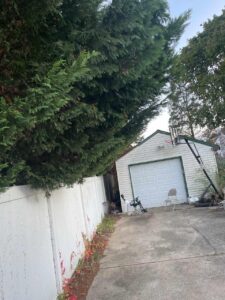
If a tree from a neighbouring garden is overhanging your property, you do have the right to deal with it, but only within certain limits.
You are entitled to:
- Cut back branches to the boundary line
- Deal with encroaching roots on your side
However:
- You must not go beyond the boundary without permission
- You should not cause unnecessary damage to the tree
- You remain responsible for how the work is carried out
Any cut material technically belongs to the tree owner and should be offered back (NOT thrown over the fence!), although in practice, many neighbours are happy for you to deal with it. If this is the case, the material becomes your responsibility.
A quick, friendly conversation beforehand usually avoids any issues.
Your Responsibilities as a Tree Owner
If you own a tree, you have a duty to take reasonable care that it does not pose a foreseeable risk.
This does not mean trees are expected to be risk-free. It means they should be inspected and maintained in a sensible, proportionate way.
In legal terms, this duty is guided by legislation such as the Occupiers’ Liability Act 1957 and the Occupiers’ Liability Act 1984, as well as industry guidance such as the National Tree Safety Group recommendations.
In practical terms, it comes down to:
- Keeping an eye on your trees
- Acting on obvious defects or concerns
- Seeking professional advice where more clarity is needed.
A Note on Roots and Damage
Tree roots can sometimes cause concern, particularly near buildings, walls, or paving.
If damage is suspected, it is important not to jump to conclusions. Trees are often blamed when they are not the true cause.
A proper assessment is always the safest starting point before any work is carried out. A tree can always be pruned or removed later, should it be the cause; it’s very hard to put it back if something else has caused the damage.
What About the ‘Right to Light’?
While your home may have a legal ‘right to light’ under the Rights of Light Act 1959, typically after 20 years of uninterrupted daylight through a window, this law rarely applies to trees. It’s mainly used in disputes about new buildings blocking established light.
Gardens and patios are not covered by this right at all. However, suppose a high evergreen hedge (not a single tree) causes significant year-round overshadowing. In that case, your local council may be able to act under the High Hedges section of the Anti-social Behaviour Act 2003.
Thinking of Selling Your Home?
Any tree-related disputes must be disclosed when selling a property, even if they have been resolved informally. The Property Information Form (TA6), which is part of the conveyancing process, specifically asks about neighbour disagreements. Failing to disclose could result in legal action in the future.
Protected Trees: What You Need to Know
Some trees are legally protected, which means you cannot carry out work on them without permission or by making an official notification to the Local Authority.
The most common forms of protection are:
- Tree Preservation Orders (TPOs)
- Conservation Area restrictions.
These are administered by your local council under legislation such as the Town and Country Planning Act 1990.
If a tree is protected:
- You must apply to, or notify the Local Planning Authority, before carrying out work
- Even pruning can require consent
- Unauthorised work can lead to significant fines.
The process is usually straightforward:
- Apply to give notice to the Council
- Provide details of the proposed work
- Wait for approval (or the end of the notice period) before proceeding.
We often handle this process for clients to make it as simple as possible.
In Summary
- You can cut back branches or roots that cross your boundary, but not beyond it, and not if it harms the tree.
- Always check for TPOs or conservation area restrictions before pruning.
- Speak to your neighbour first and try to resolve the issue amicably.
- Use a professional arborist for anything beyond light trimming.
- Mediation is often quicker, cheaper and more effective than court.
- ‘Right to light’ rarely applies to trees and doesn’t cover gardens.
- Declare any past disputes when selling your home, even informal ones.
Final Thought
Most issues around trees and boundaries are resolved quickly once the facts are clear.
- A bit of understanding and a sensible approach usually goes a long way.
- If you are ever unsure where you stand or what the best course of action might be, it is always worth getting advice before picking up the saw.
- If you would like us to take a look or simply talk things through, we are always happy to help.