The Hidden Life of Trees: Why Bugs Matter More Than You Think 🐞🌳
When we look at a tree, we tend to notice the obvious: the shape, the leaves, the blossom and perhaps the shade it casts on a warm day.
But what we don’t often see is the extraordinary world of insects living in, on and beneath that tree. Without them, trees and the wider landscape wouldn’t function as they do.
Bugs aren’t just visitors to trees. They are part of the system.
A Life Lived in Trees (and Beneath Them)
Some insects rely on trees for their entire lifecycle, often in ways that go completely unnoticed.
Take certain species that spend years underground feeding on tree roots, only emerging briefly as adults to live in the canopy. Their lives are tied directly to the health of the soil, the roots and the structure of the tree above.
This reminds us of something important:
👉 Trees aren’t just what we see above ground; they are part of a much larger living system below ground.
Trees as Homes – Not Just Plants
For many insects, trees are not just food sources; they are homes.
- Cavities in trunks provide nesting sites
- Bark offers shelter from predators and weather
- Leaves support caterpillars and other larvae
- Dead wood becomes a habitat for thousands of species
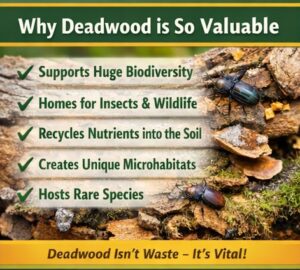
In fact, nearly 2,000 species of invertebrates in the UK depend on dead wood alone
This is why older trees, particularly ancient and veteran trees, are so important. They provide the cracks, decay, fungi and complexity that younger trees simply haven’t developed yet.
A tidy tree isn’t always the most valuable one.
It’s Not Just About Honeybees
When we talk about insects, the conversation often turns quickly to bees, particularly honeybees.
But here’s the reality:
👉 Honeybees are just one small part of a much bigger picture.
There are hundreds of species of wild bees, alongside hoverflies, beetles, moths and countless other insects, all playing vital roles in pollination and ecosystem health.
In fact, focusing too heavily on honeybees alone can sometimes put additional pressure on wild pollinators competing for the same limited food sources.
Trees, especially flowering and native species, provide a far broader and more balanced food supply for this diverse community.
Trees as Feeding Stations
From early Spring through to late Autumn, trees provide a steady supply of food for insects:
- Spring blossom fuels emerging pollinators
- Leaves feed caterpillars and larvae
- Sap and bark support specialised insects
- Decaying wood feeds decomposers
And it doesn’t stop there.
The insects that trees support go on to feed birds, bats and other wildlife, meaning trees sit right at the centre of the food chain.
The Importance of Connected Habitats
One of the biggest challenges facing insects today is not just habitat loss, but habitat fragmentation.
Insects need to move between feeding, breeding and sheltering areas. When landscapes become disconnected, populations struggle to survive.
That’s why linked habitats, trees, hedgerows, gardens and wildflower areas are so important, creating pathways that allow insects to move and thrive across the landscape.
Your garden, however small, is an important part of that network.
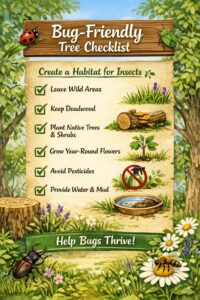
What Gardeners Can Do
The good news is that supporting insects through your trees and shrubs is straightforward, and often involves doing less, not more.
🌿 Let parts of the garden stay natural
Leaf litter, long grass and undisturbed corners provide shelter and breeding sites.
🪵 Keep some dead wood
A log pile or decaying branch can support an entire ecosystem.
🌸 Plant for continuity
Choose trees and shrubs that flower at different times to provide food throughout the season.
🌳 Value mature trees
Older trees offer far greater ecological value than newly planted ones.
🚫 Reduce pesticide use
Many chemicals harm beneficial insects as much as pests.
A Different Way of Looking at Trees
Once you begin to notice the insects around your trees, your perspective shifts.
- That hole in the trunk becomes a home.
- That fallen branch becomes habitat.
- That blossom becomes a feeding station.
Trees stop being individual features and start becoming living ecosystems.
A Final Thought
It’s easy to overlook the small things. Insects are doing the quiet work that keeps our gardens, woodlands and countryside functioning.
By caring for our trees and allowing them to be just a little bit wild, we’re not just managing landscapes, we’re supporting the life that depends on them.
In many ways, that life is holding everything else together.