The Hedge That Does Everything
A closer look at the Common Hawthorn
There are some trees that people go out of their way to see, and then there are those that get on with things in the background.
The Crataegus monogyna firmly belongs in the second group.
It’s the hedge you drive past without noticing. The boundary you lean on while talking and the slightly prickly presence that quietly defines the edges of fields, lanes and gardens across the country.
Yet, once you start looking a little more closely, it becomes clear that Hawthorn might just be one of the hardest-working trees we have.
A hedge first and a tree second
For most of its life, Hawthorn isn’t really allowed to be a tree.
It’s clipped, shaped, reduced and contained and trained into hedges that have been marking boundaries for centuries. Dense, thorny and incredibly resilient, it does the job better than almost anything else.
Plus, those thorns are not accidental.
They make Hawthorn an excellent natural barrier, one that livestock tend to respect, and people approach with just a bit more care than they might a fence. Long before wire and posts became the norm, Hawthorn hedges were the countryside’s way of drawing a line and meaning it. In many places, they still are.
Spring doesn’t sneak in; it bursts into life in beautiful white blossom!
If Hawthorn spends much of the year being overlooked, Spring is when it changes that.
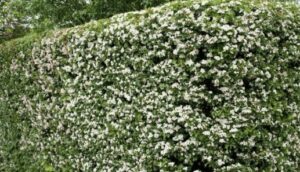
Seemingly overnight, hedgerows that have been quietly ticking along burst into flower. Clouds of small white blossoms appear along the branches, brightening the landscape in a way that feels almost sudden.
This is “May blossom”, although, as anyone who keeps an eye on these things will tell you, it often arrives in April.
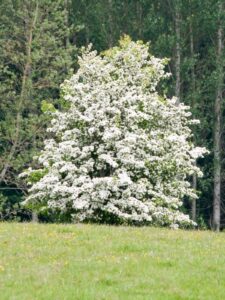
There’s something about Hawthorn in flower that feels reassuring. It marks a shift in the season, a moment where things tip properly into growth and warmth.
Stand near a flowering hedge, and you’ll notice the sound as much as the sight as bees move steadily from flower to flower, making full use of what the tree has to offer.
By Autumn, those flowers have given way to berries, the familiar red “haws” that line the branches. They’re easy to overlook, but they’re doing important work.
For wildlife, Hawthorn is a lifeline. Birds rely on those berries as the colder months approach, and the dense structure of the hedge provides shelter and nesting sites throughout the year. In ecological terms, hawthorn punches well above its weight.
For people, the uses are there too, if slightly less well known these days. Haws can be used to make jellies, sauces and even a form of ketchup. They’ve also been used traditionally in herbal remedies, particularly in relation to heart health. It’s one of those plants that has quietly supported both people and wildlife for generations, without ever making a fuss about it.
Tough, adaptable, and surprisingly long-lived, the Hawthorn is certainly not delicate.
It will grow in poor soils, tolerate exposure, and cope with repeated cutting in a way that would finish many other species. That resilience is one of the reasons it has become such a cornerstone of the British landscape.
Given the chance, though, Hawthorn reveals a different side.
Left uncut, it develops into a small tree with a rounded crown, twisted branches and a surprising amount of character. Some specimens live for hundreds of years, slowly thickening and hollowing in the way that so many of our native species do.
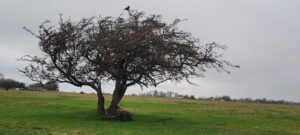
At that point, it becomes something else entirely, less a hedge, more a presence.
Hawthorn has always had a place in British folklore. It’s associated with May Day, with renewal, with boundaries not just of land but of something slightly less tangible. In some traditions, it was considered lucky; in others, best left undisturbed.
There’s often a solitary Hawthorn standing in a field somewhere that seems to carry more weight than its size would suggest. Not large, not grand, but somehow significant.
You don’t need to believe in folklore to feel that.
Perhaps the most interesting thing about Hawthorn is how easy it is to ignore. It doesn’t demand attention. It doesn’t dominate a space. It simply does what it has always done, quietly supporting life, defining landscapes and marking the passing of the seasons.
But when you do stop and look at it properly, it’s difficult not to come away with a bit more respect.
This is a tree that:
-
builds boundaries
-
feeds wildlife
-
supports pollinators
-
offers seasonal beauty
-
and carries centuries of history in its branches
All while being trimmed back year after year without complaint.
So next time you find yourself alongside a hawthorn hedge, whether it’s in flower, in fruit, or simply standing there doing its job, it’s worth taking a moment and looking a little closer.
What seems ordinary at first glance is, in fact, doing an extraordinary amount of work.
Like many of the best things in our landscape, it’s been there all along without us even noticing.
I would just like to add a big thank you to Sarah Downs for her ideas, adding depth, character and a fresh perspective to each piece.
Author: Martin Jenkins