Where the Trees Step Back
(A quiet look at Rodborough Common)
There are places where trees take centre stage, and then there are places where they don’t.
Rodborough Common is very much the latter.
At first glance, it’s all about the openness. Wide skies, rolling ground, long views stretching out across the valley. It’s a place that feels expansive, almost deliberately uncluttered, the sort of landscape where you can see the weather coming before it arrives. This is exactly how it’s meant to be.
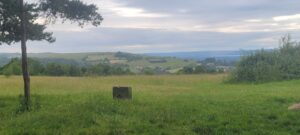
Not every landscape wants trees, and it’s easy to assume that more trees are always better.
More planting, more cover, more greenery make it feel like the obvious answer, but landscapes like Rodborough Common tell a slightly different story.
This is grassland, shaped over centuries by grazing, weather and use. The openness isn’t an absence of trees; it’s a result of careful balance. A landscape held in place by what’s not allowed to take over.
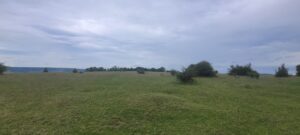
Left entirely to its own devices, this space would slowly begin to change. Scrub would move in first, and then young trees. Given enough time, woodland would follow, and whilst that might sound like progress, it would be a loss of something equally valuable.
What about the trees at the edges?
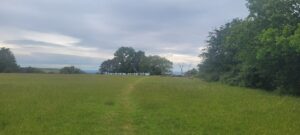
That’s not to say there are no trees here, they’re just… selective!
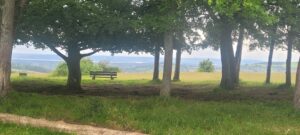
You’ll find them at the margins — along boundaries, tucked into dips, or standing slightly apart from the open ground and then when you do notice them, they feel more significant for their restraint.
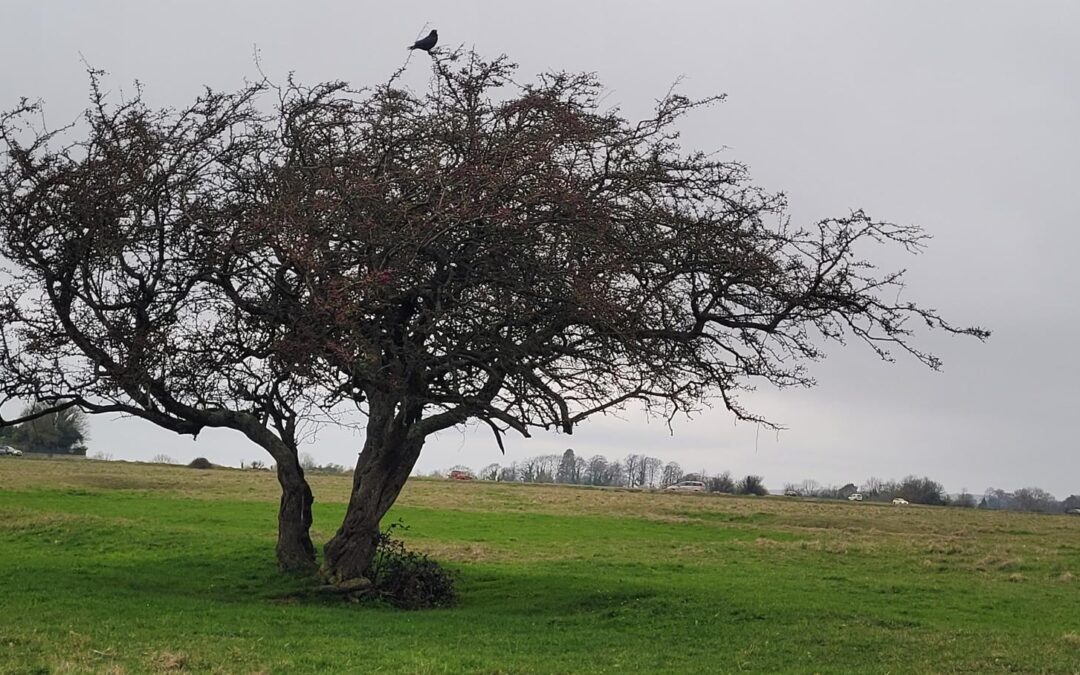
A lone tree on a common has a very different presence from one in a woodland.
It stands against the sky rather than within a canopy. Its shape is clearer and its structure more exposed. Wind, light and space all leave their mark in ways that are easy to see.
These are not sheltered trees; they are shaped by where they are.
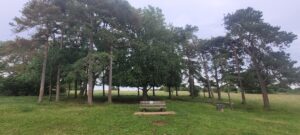
Grown by the elements
Spend a little time looking at the trees on Rodborough Common, and you start to notice how much the environment has influenced them.
Branches lean away from prevailing winds. Crowns spread low and wide rather than reaching upward. Some appear almost sculpted, not by design, but by years of steady pressure from the elements. It’s a reminder that trees are not fixed forms.
They respond, adjust and adapt, and on an exposed site like this, that relationship between tree and environment is laid out very clearly.
A working landscape
Rodborough Common isn’t just a scenic space — it’s a working one.
Grazing plays a key role here, and it’s one of the reasons the landscape remains open. Livestock naturally limit the spread of scrub and young trees, holding back succession and maintaining the character of the common.
It’s a quiet kind of management, not heavy-handed, not intrusive — just consistent. The sort of approach that allows a landscape to remain itself over time. Without it, things would look very different.
The balance of letting go
There’s an interesting tension in places like this. On the one hand, there’s a desire to let nature take its course, and on the other, there’s a recognition that what we value here, the openness, the views, the grassland, only exists because of ongoing intervention.
It’s not about control for its own sake.
It’s about understanding what the landscape is, and what it needs to remain that way.
And in this case, that means knowing when to hold things back rather than letting them move forward unchecked.
Seeing what’s not there
What makes Rodborough Common particularly interesting is that it encourages you to notice absence.
The lack of dense woodland and the gaps between trees. The uninterrupted lines of sight.
It’s not something we’re always used to appreciating.
But once you start to see it differently, the space itself becomes the feature — and the trees, rather than filling it, begin to frame it.
A different kind of value
In a world where tree planting is often (quite rightly) encouraged, places like Rodborough Common remind us that value comes in different forms.
This landscape supports its own ecology, one that depends on openness rather than canopy. Wildflowers, invertebrates, and ground-nesting birds all rely on conditions that trees would eventually change.
It’s not better or worse (for trees?); just different and worth keeping.
Taking a moment
So next time you find yourself on Rodborough Common, it’s worth pausing for a moment.
Not just to look at the view — though it’s hard not to — but to notice how the space works.
- Where the trees are
- where they aren’t
- and why that matters
Because sometimes, understanding a landscape isn’t about what’s present, it’s about recognising what’s being quietly held back.